
How to advocate for your neurodivergent child at school
How to Advocate for Your Neurodivergent Child at School
When your child is struggling at school, it can be hard to know where to start.
You might be hearing that they’re refusing work, struggling with transitions, not participating, spending increasing amounts of time outside the classroom, or simply not getting to school at all.
Or perhaps school tells you they’re doing fine, while you’re seeing a completely different child at home.
Advocating for your child doesn’t mean you need to walk into school with all the answers. And it doesn’t have to begin from a place of conflict.
Often, some of the most useful advocacy begins with helping everyone around the child slow down, get curious and develop a more complete understanding of what’s happening.
Start with a different question
When a child isn’t doing something expected of them, it’s easy for the conversation to become focused on behaviour:
Why won’t they do it?
How do we get them to participate?
How do we increase their attendance?
What consequence or incentive might work?
I prefer to begin somewhere different:
What is making this hard?
There can be so much sitting underneath what we see.
Sensory overload. Uncertainty. Social demands. Fatigue. Learning differences. Transitions. Loss of autonomy. Previous experiences at school. Relationship ruptures. Anxiety. Masking. A nervous system that is already operating close to capacity.
For children with a PDA profile, even seemingly ordinary expectations can sometimes be experienced by the nervous system as a threat to autonomy or safety.
What looks like won’t can very easily be can’t right now.
Changing that lens changes the kinds of support we consider.
When home and school see different children
One of the most difficult experiences for families can be hearing:
“But they’re fine at school.”
Sometimes they genuinely do appear fine.
A child might be participating, following instructions, completing work and holding themselves together throughout the school day, while using an enormous amount of internal capacity to do so.
Then they get home.
We might see exhaustion, distress, shutdown, explosive emotions, withdrawal, an increased need for control or very little capacity for everyday expectations.
Neither experience necessarily cancels out the other.
What school sees can be true. What you see at home can also be true.
The useful question becomes:
What does the difference tell us?
This is one reason we need multiple perspectives when understanding a child's wellbeing at school. Recent research into autistic student wellbeing has similarly highlighted the importance of autistic students' own perspectives alongside information from the different people and environments around them.
Listen to your child
Your child is one of the most important sources of information about their school experience.
That doesn’t necessarily mean sitting them down and asking lots of direct questions, or expecting them to attend a meeting full of adults and explain what they need.
Listening might mean noticing:
what they say in the car after school
the lessons, places or times of day they repeatedly avoid
what happens in their body when school is mentioned
what they communicate through play, drawing or interests
where they seem comfortable and connected
which adults they trust
when their capacity noticeably increases or decreases
what happens once they return to the safety of home.
Sometimes behaviour itself is communication.
Autism CRC’s new National Guidance for best practice in inclusive education for autistic students includes student-centred and student-informed practice among its nine guiding principles, alongside collaboration, personalisation, proactive and coordinated action, rights-based decision-making and supportive environments.
We don't just want to plan for children. We want to find accessible ways of planning with them.
Sometimes we need to consider burnout
Sometimes families and schools make adjustment after adjustment and nothing seems to shift.
At this point, I think it is important to consider the child's overall capacity.
Could this young person be burnt out?
Autistic burnout is still an emerging area of research, particularly in children, so we need to be careful about presenting it as something we can neatly identify from a checklist. However, research with autistic people describes burnout as involving significant exhaustion and increased difficulty with everyday functioning, with sensory and social overwhelm, camouflaging and ongoing demands among the factors that can contribute. Rest, sensory relief and appropriate support have been identified as important parts of recovery.
When a child is burnt out, the goal may need to change.
This may not be the time to focus on achieving the things that currently feel hardest.
Getting to school on time.
Completing all the work.
Increasing attendance.
Tolerating another difficult environment.
Instead, we may need to create enough space for genuine recovery.
That can mean significantly reducing demands and increasing access to the things that help this particular child regulate and restore.
For one child that might be water.
For another it might be hours spent immersed in a favourite interest.
It might be jumping on the trampoline, drawing, gaming, being outside, spending time with animals, moving their body, being alone, or being close to a trusted person.
Recovery doesn't necessarily look like lying quietly in bed.
And it can take longer than the adults around a child expect.
One of the things I often come back to is:
Our children often show us where their actual capacity is.
We need to be careful that we aren't continually responding to that information by asking them to demonstrate the capacity we think they should have.
Create regular opportunities for collaboration
If your child is experiencing ongoing difficulty and communication with school mostly happens at drop-off, pick-up or when something has gone wrong, consider asking for regular meetings.
For example, in Victorian government schools, a Student Support Group can bring together parents, school staff and, where appropriate, the child and relevant therapists. These meetings can support the development, implementation and review of an Individual Education Plan and other support plans.
Depending on your child's circumstances, you might be discussing an:
Individual Education Plan (IEP) or Individual Learning Plan (ILP)
Behaviour Support Plan
Attendance Support Plan
Safety or other individual support plan
The name of the document matters less to me than the process around it.
We want plans to be developed collaboratively.
That might involve:
your child + you + school + relevant professionals
Your child's OT, speech pathologist, psychologist, social worker or another professional doesn't necessarily need to attend every meeting.
Sometimes their involvement might mean attending an important planning meeting. At other times, you might ask them to review a draft plan, provide written recommendations or communicate with the school about a particular area of their work.
Within Victoria the Department of Education's guidance is that collaborative planning is best practice. For example, Individual Education Plans can be developed in consultation with the student, school and Student Support Group, while Attendance Support Plans can involve the student, parent and relevant supports.
A plan isn't the outcome
Having an IEP sitting in a folder doesn't necessarily change a child's experience.
The question is:
Is what we've planned actually helping?
I like to think of planning as an ongoing cycle:
Listen → Plan → Trial → Notice → Review → Adjust
If something helps, document it.
If something consistently makes things harder, document that too.
This becomes especially important when there is a relief teacher, a staff change, a transition into another classroom or a new school year.
The knowledge we've gained about a child shouldn't disappear every time the adults around them change.
You don't need to know exactly what will work
Sometimes advocacy gets stuck because everyone is trying to establish exactly why something is happening before they're willing to make a change.
We don't always need certainty.
Sometimes we can simply ask:
What could we trial?
Perhaps the child can enter through a quieter gate.
Perhaps they don't attend assembly for a while.
Perhaps maths happens somewhere else.
Perhaps they have regular access to movement rather than needing to become distressed before receiving a break.
Perhaps an adult changes the way they phrase expectations.
Perhaps the timetable needs to reduce temporarily.
Try it.
Notice what happens.
Ask the child.
Then come back together and review it.
Support plans should be working documents rather than static descriptions of what a child is supposed to do.
Questions to take into your next school meeting
You don't need a perfect script, but these questions can help move a conversation from managing behaviour towards understanding and collaborative problem-solving:
What are we noticing?
When is this easier, and when is it harder?
What tends to happen beforehand?
What does our child tell us about this?
What seems to increase or decrease their capacity?
What accommodations are already helping?
What could we trial?
Who is going to do what?
Where will we document what we've agreed to?
When will we meet again to review it?
If you're raising a concern, it can also help to go into the conversation knowing what you would like to be different, while remaining open to developing the solution together. ACD has some excellent practical guidance for Victorian families on preparing for meetings and raising concerns with schools.
You bring important knowledge to the table
Parents sometimes feel they need to become experts in education policy, disability legislation, autism or PDA before they are qualified to advocate.
You don't.
School staff bring their knowledge of the learning environment.
Professionals may bring specialist knowledge and another perspective.
You bring a deep knowledge of your child across environments and over time.
And your child brings something nobody else can provide: their lived experience of being themselves.
Good collaborative planning makes space for all of those perspectives.
This is also reflected in Australia's new National Guidance for inclusive education for autistic students. Released by Autism CRC in 2026, the Guidance is informed by seven systematic literature reviews involving 507 included studies, consultation with more than 800 people including autistic young people, and input from autistic people, parents, educators, allied health professionals and education-system leaders.
For me, one of its most useful messages is that inclusion isn't simply about getting an autistic child physically into a classroom.
We need to be thinking about safety, belonging, engagement and success.
Useful resources for families
Autism CRC: National Guidance for best practice in inclusive education for autistic students
This is a fantastic new resource for Australian families, educators and professionals.
It provides an evidence-informed, neurodiversity-affirming and rights-based foundation for inclusive education in mainstream Australian schools, with guidance across wellbeing and belonging, teaching practices, collaboration and leadership, and the physical environment.
Link to Autism CRC National Guidance
Association for Children with a Disability (ACD)
For Victorian families, ACD has excellent information about Student Support Groups, Individual Education Plans, raising concerns with schools and advocating for your child.
ACD also operates a free Support Line for Victorian families of children with developmental delay or disability, which can help families understand rights, prepare for meetings and work out next advocacy steps.
School Can't Australia
If your child is experiencing significant distress around school attendance, School Can't Australia offers lived-experience-informed information and resources specifically around school attendance difficulties.
Their free Understanding School Can't guide includes information about working with schools and preparing for meetings, and their broader parent resources cover areas including stress, safety, trauma and education options.
Understanding Zoe
A clever app designed by parents of a neurodivergent child with a PDA profile to support communication between everyone around the child, to track information (reports, plans, medical docs, IEPs), keep track of medication, appointments and more. My favourite part? Pip, the AI assistant who has access to carefully curated resources and is there to chat with you 24/7 about anything. Support to process what's happening, suggestions for how to approach things and logging of observations. You can make Pip available to teachers, allied health professionals, support workers and more - it's up to you who you add to the app.
Visit Understanding Zoe website
Supporting a child at school
If your child has a PDA profile and you're trying to help the adults around them better understand what is happening, I've created several resources specifically to help translate that understanding into everyday school practice.
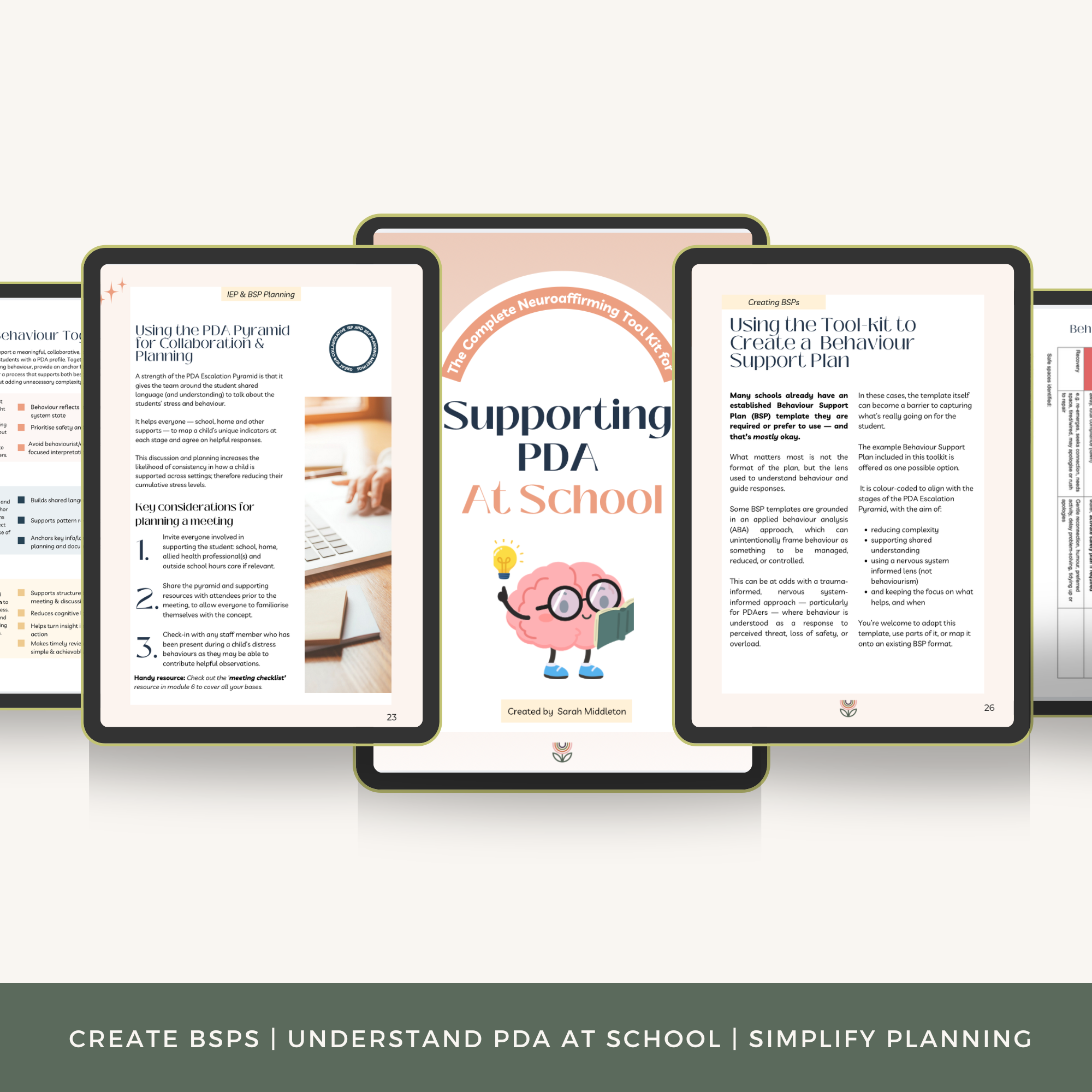
The Complete Toolkit for Supporting PDA at School is a resource I developed to help families, teachers and professionals move from understanding what might be happening underneath behaviour to developing practical, individualised support. It's designed to build shared understanding and language, along with collaboration and effective planning.
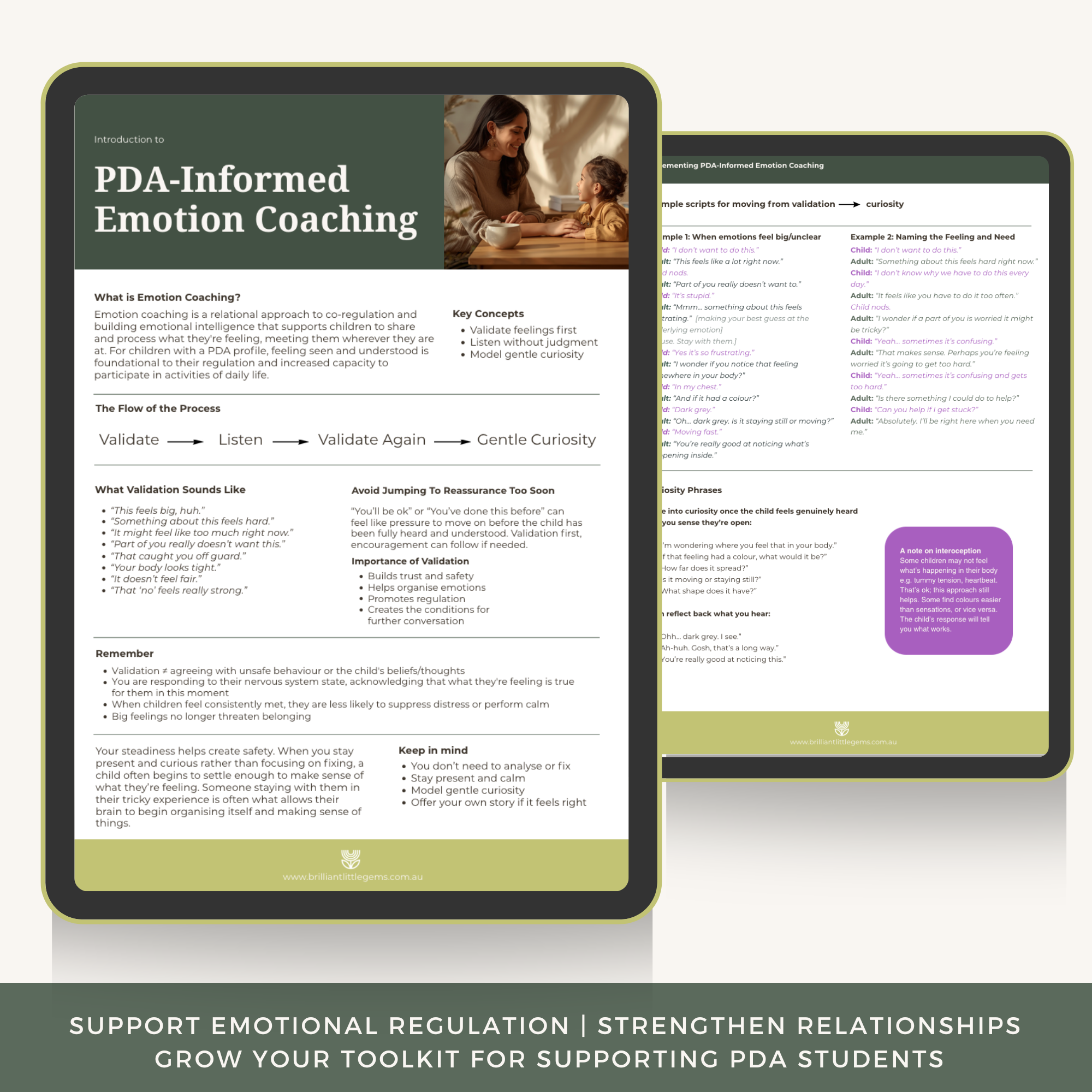
My PDA-informed Emotion Coaching resource offers another way of supporting children to understand and communicate their internal experience without turning emotional regulation into another demand.
Link to PDA-informed Emotion Coaching
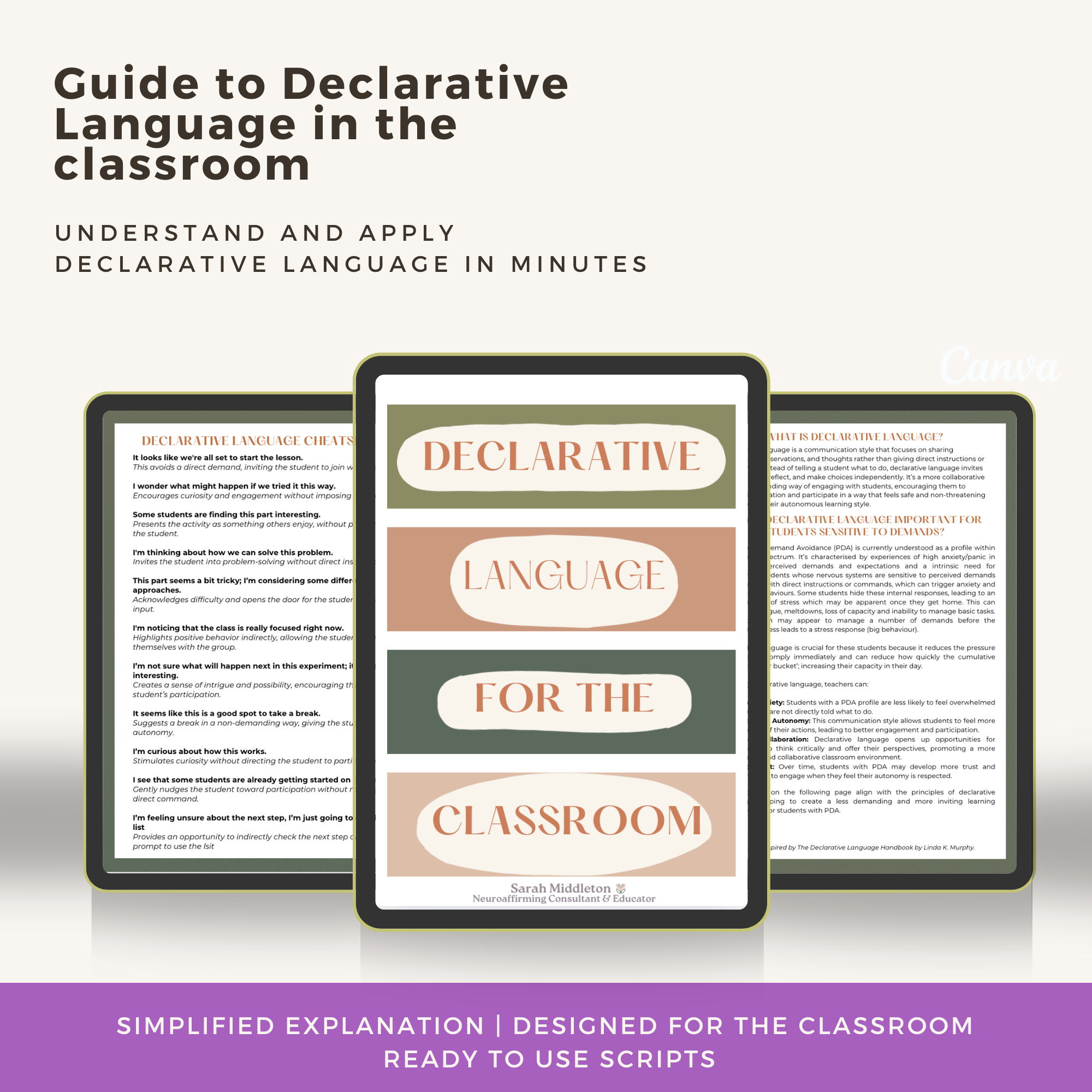
FREE Declarative Language at School resource
One final thought
Advocacy doesn't always mean pushing harder, sometimes it means asking a different question.
Sometimes it means bringing another person into the conversation.
Sometimes it means asking for something to be written down.
Sometimes it means saying, “We've tried this for six weeks and their capacity is getting worse. I think we need to reconsider the plan.”
And sometimes it means helping everyone around a child recognise that the child is already giving us information about what they need.
Our job is to get curious enough to hear it.