Do Rewards Work for Children With a PDA Profile?
I’ve recently been asked about why it’s not recommended to use rewards with children who have a PDA profile.
It’s such a thoughtful question. And if I’m honest, it led me into a whole series of other questions too.
So maybe we can start here…
What’s actually happening inside a child with a PDA profile when rewards are used?
As I was sitting with this, I came across the work of Steph Curtis. Steph is a parent of a PDA child and the author of PDA in the Family: Life After the Lightbulb Moment. Her writing captures something I’ve witnessed over and over again in both my work and my own life.
The cycle in the image below tells a story that behaviour data rarely holds.
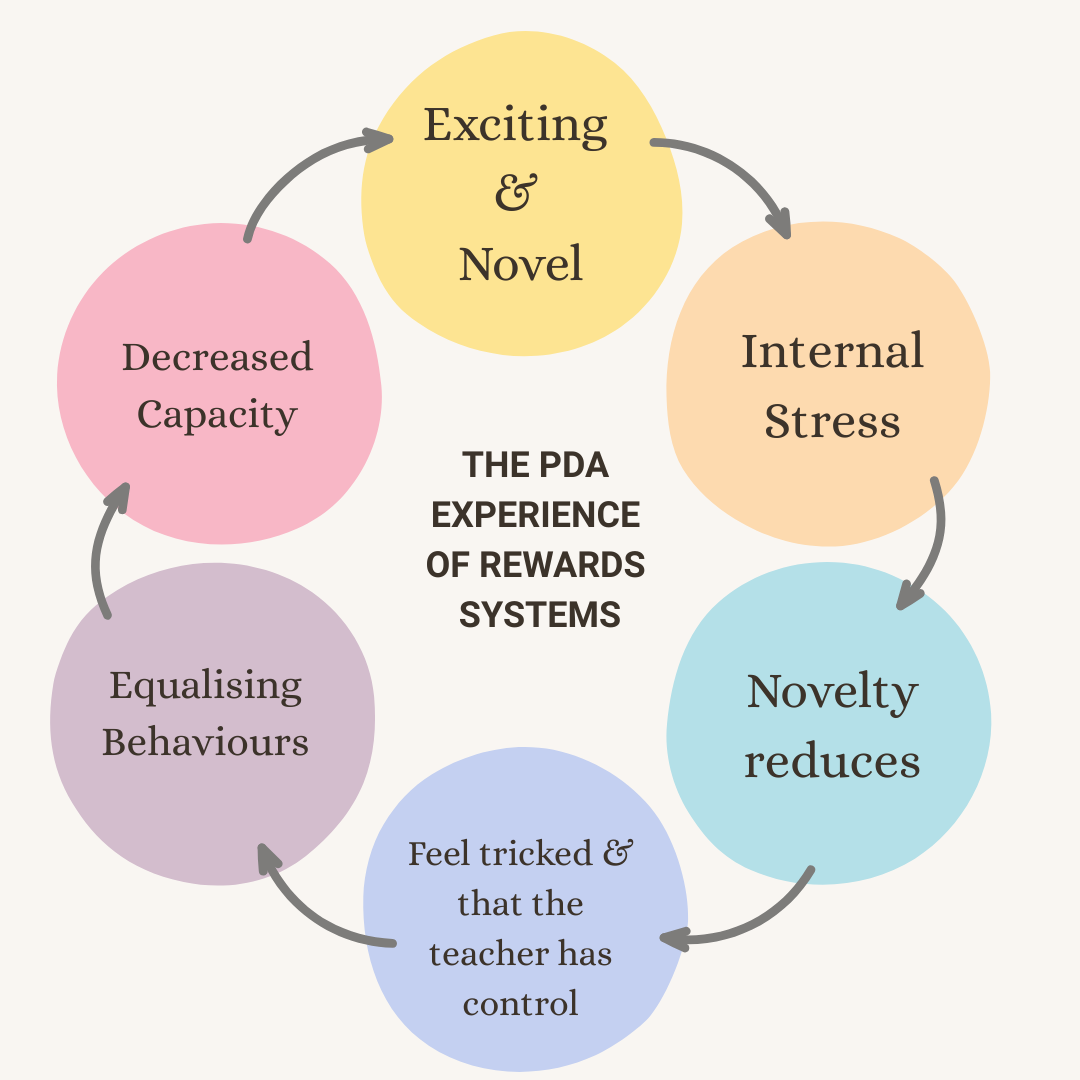
It often begins with excitement. There’s novelty. A sense of possibility.
We might see a child throwing themselves into the system — masking, performing, trying so hard to make it work.
And on the outside, it can look like success.
But underneath, something else is already happening.
The effort of performing, complying, meeting expectations, it comes at a cost. The nervous system is being activated from the very beginning, even if we can’t yet see it.
Then the novelty starts to wear off.
But the demands don’t.
And this is where we often see a shift.
The child begins to recognise — consciously or not — that rewards are being used to shape their behaviour. To influence them. To move them away from their own internal sense of self and towards something externally defined.
For a child with a PDA profile, this can land as a threat to autonomy and a lack of equity in the relationship — two huge factors which undermine felt safety and activate stress responses.
What we often see next are what I think of as equalising responses — resistance, negotiation, refusal, power struggles. Not because the child is being oppositional, but because their system is trying to restore a sense of safety, to 'make things right'. They know that if they feel safe, they can do the rest.
This is one of the most challenging and distressing parts of being a PDAer - knowing that you need to find that 'homeostasis' the safety - and it also being so incredibly hard to access. Being surrounded by expectations, demands, direct questions, bright lights, noise and existing within a naturally hierarchical structure such as a school is akin to a minefield.
Over time, with so much effort put in, so many landmines avoided, yet so many things still feeling like they're falling short of what's expected, there’s a draining of capacity. It's the drip drip drip of the water tank, with the occasional gushing loss of capacity that leads to our little gems feeling they have nothing left.
Holding it together. Masking. Pushing through.
There’s only so long a body can do that.
Sometimes this shows up at school — avoidance, arguing, shutting down.
Sometimes it shows up at home — big emotions, meltdowns, words that feel sharp and hard. Fatigue, sleeping, shutdowns, loss of appetitie. No capacity to brush teeth, or follow a simple instruction.
Often it’s both, but on the occasions it's just in one setting then masking is the most likely cause.
All of this is what the SWPBS data doesn’t capture.
Not just what the child did — but what it cost them to do it.
Next, I'll be sharing my thoughts in response to the 'So what actually helps?'
Want this information and suggestions for alternatives to rewards-based systems for students with a PDA profile? You'll find the PDF download here.
If you’d like more practical to support this in a school setting, I’ve brought together strategies, planning tools and ways of thinking about support inside my PDA Toolkit for Schools 🤍